
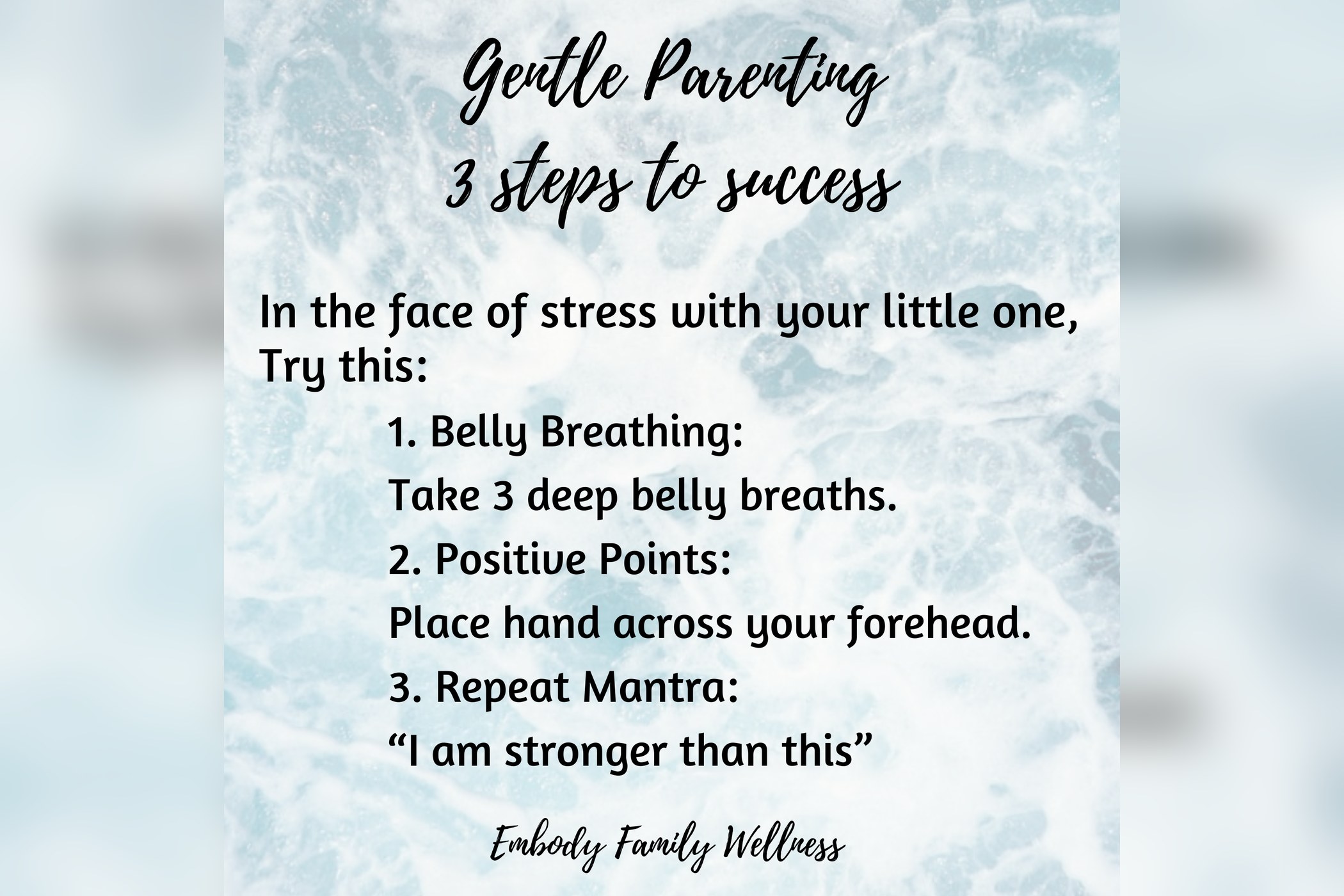
When your child is having a hard time, it is hard for either of you to think clearly. These are three quick exercises I use to bring a sense of calm and clarity to a tricky moment. Two of them come from Brain Gym®. They can be done almost at the same time, anywhere, anytime, in less than 15 seconds.
I’m Michele, a Brain Gym® Consultant and Primitive Reflex Integration Practitioner in Perth, and a mum of three. I started using these to help with parenting my own little ones.
Key takeaways
- Three quick exercises: belly breathing, Positive Points and a calm phrase to repeat.
- They can be done anywhere, almost at the same time, in less than 15 seconds.
- Calm first, then the thinking can come back, for parents as well as children.
Why calm comes before thinking
Quite often in stressful situations we hold our breath. When the brain is in a stressed state, it cannot move between its two sides as well, so organising, communicating and making plans all get harder. That goes for us as parents too. Calm first, then the thinking can come back.
1
Belly breathing
Breathing slow and deep calms the nervous system and gives the brain and body the oxygen they need for thinking clearly. Make a conscious effort to breathe in until the belly expands, then fully empty the lungs so fresh air can come in with the next breath.
Try three deep belly breaths. You can do them on your own, or with your child.
2
Positive Points
Gently place a hand across the forehead. In Brain Gym® there are pressure points here called the Positive Points. Holding them is used to bring energy to the frontal lobe, the part of the brain we use for logical thinking, so it is easier to come up with a new solution without the emotions taking over.
3
A calm phrase to repeat
This one is not a Brain Gym® exercise, but positive self-talk can be really useful. Mine is “I am stronger than this”.
In the heat of the moment it reminds me to ask myself whether I really need to be wound up over this. I am the role model here, and I need to be calm and in control so I can help the little one who is having a hard time. Find a phrase that works for you.
I use these three in my sessions, along with a few others. I keep it to these three here as a simple starting point for parents.

“I am the role model here, I need to be the stronger person, in control and calm so that I can help this little being that is having a hard time.”
Michele Henrick, Embody Family Wellness
When to use them
Next time you feel yourself getting reactive, or your child is getting wound up, try all three together. If your child is wriggly rather than upset, a short burst of movement can help first. My movement breaks post has 12 simple ideas.
For more ways to help the whole family stay calm, from slow breathing to time outside, read calming your child’s nervous system.
- 1Belly breathingthree deep breaths
- 2Positive Pointsa hand across the forehead
- 3A calm phrasefind one that works for you

When it might be more than a bad day
Some children are easily overwhelmed, startle easily or have strong reactions to things other children seem to manage more comfortably. In some children, retained primitive reflexes may contribute to difficulties with emotional regulation, as well as balance, coordination and sitting still.
Brain Gym® is a series of simple body movements, and I often combine it with reflex integration. You can read more on my Brain Gym® page, or get in touch for a free phone chat about what you are noticing in your child.
What parents say
★★★★★ 5.0 from 3 Google reviews.
★★★★★
“We visited Michele for our 4yo little girl who struggled to stay on task, sit still, lacked coordination and struggled with separation. … By week 3 we had visitors comment on the changes to our household. By week 12 we had a completely different little girl, shes relaxed. She still has her beautiful spark, amazing imagination and sense of humour, life is just slower now.”
Sarah Anderson, Google review
★★★★★
“From the very first session, she created such a calm, supportive, and understanding space … The strategies and tools we’ve learned have made a real impact on his ability to regulate, connect, and thrive both at home and school.”
Natasha Weir, Google review
★★★★★
“Michele identified some unintegrated reflexes and gave us some simple, easy to do at home exercises … From the first session we saw less reactivity; and from consistently doing the exercises at home my daughter can now remain calm in situations that would previously have caused a lot of distress.”
Analise Mongan, Google review
Is there research behind it? Yes. Primitive reflex integration exercises are researched for their effect on childhood motor and neurological patterns. See the research.
Not sure where to start?
You are welcome to get in touch for a free phone chat about what you are noticing in your child.


